
What are thermostatic radiator valves?
Thermostatic radiator valves, or TRVs, are radiator valves with a numbered head that senses the air temperature around it. When the room reaches the setting, the valve closes and water stops flowing through that radiator. They let you keep a bedroom cooler than a living room without touching the boiler.
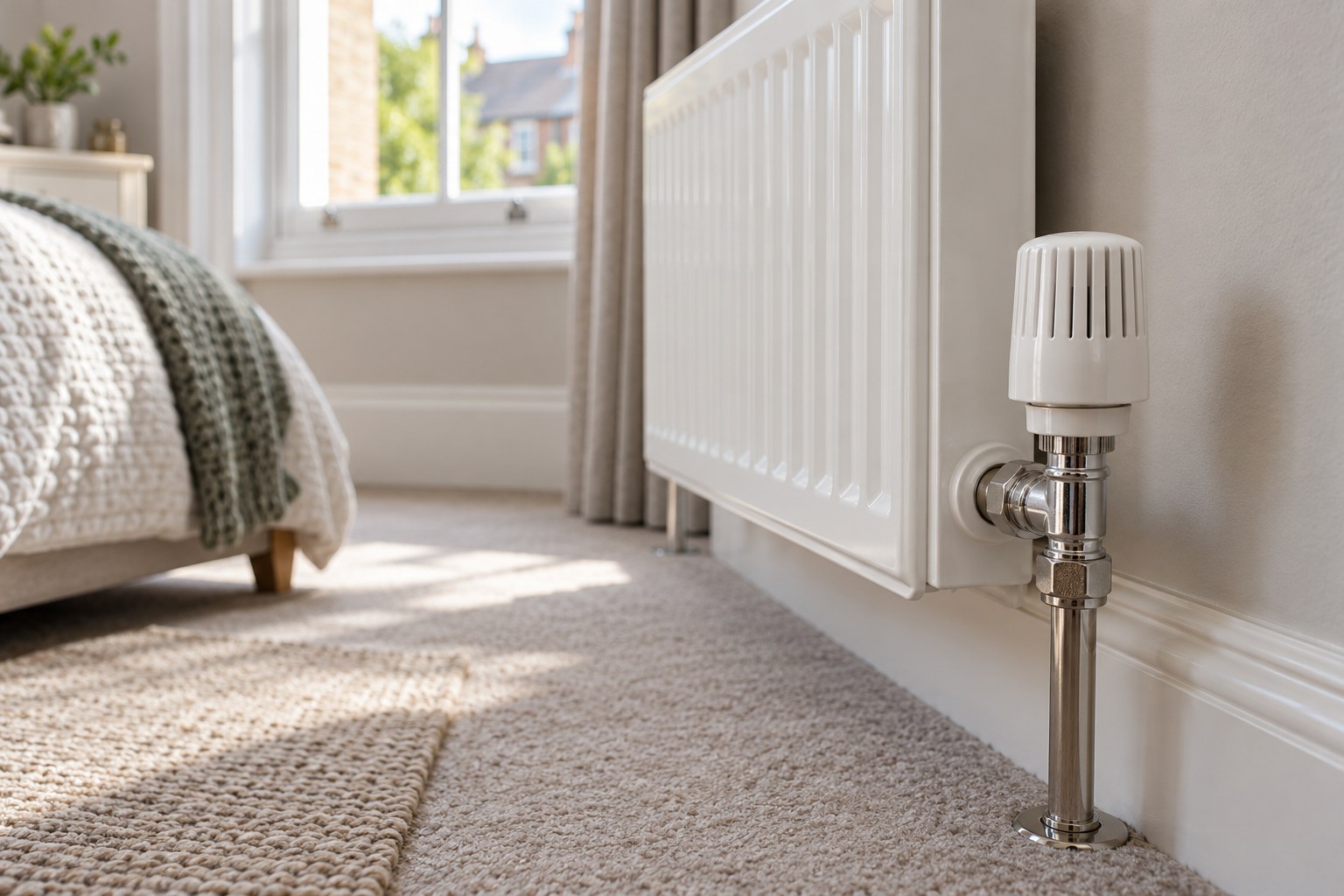
This service covers fitting TRVs where a house still has plain manual valves, replacing TRVs that have stuck or stopped working, and adding smart TRV heads that can be set from a phone app. A TRV has two parts, the valve body on the pipe and the head on top, and sometimes only the head needs changing.
Signs you need thermostatic radiator valves
- Every radiator is either fully on or off, with no way to set rooms differently
- A TRV head is set to 5 but the radiator stays cold, or set to 1 and stays hot
- The pin under the TRV head is stuck down or stuck up
- Spare rooms are being heated to the same temperature as the rest of the house
- You are planning a new boiler and want room-by-room control at the same time
- You want to schedule heating room by room with smart TRV heads
TRV options explained
- Standard TRVs. A full valve with a wax or liquid-filled head. This is the cheapest way to add room control and needs the old valve body taken off.
- Replacement heads. If the body is sound but the head has failed, a new head of the same make can often be clipped or screwed on with no draining at all.
- Smart TRV heads. Battery-powered heads that open and close the valve to a schedule set in an app. Many fit the common M30 x 1.5 thread; others need an adaptor for the valve brand. Most need a hub, and some work best with a matching smart room thermostat.
- Bidirectional TRVs. These can be fitted on either the flow or return pipe, which helps when you are not sure which way the water runs.
If TRVs are fitted on every radiator, the boiler may need an automatic bypass valve so water can still circulate when all the valves close. The radiator in the room with the wall thermostat is usually left without a TRV so the two temperature controls do not compete.
What to include when asking for a quote
List how many radiators you want TRVs on, and say which room has the wall thermostat. Note whether any radiators already have TRVs and what make they are; the brand name is usually on the head or the body. Photos of the valves showing the pipe entry help the engineer judge straight or angled patterns.
If you want smart heads, say which system you have in mind, or ask the engineer to suggest one that works with your boiler and thermostat. Check whether the quote includes the hub, adaptors and setting up the app, or only fitting the valves.
Ask whether the engineer will check for a bypass on the boiler, drain or freeze the pipes, refill with inhibitor and balance the radiators. TRVs fitted to an unbalanced system will not give the even heating you are paying for.
How much do thermostatic radiator valves cost to fit?
| Type of job | Typical cost |
|---|---|
| Two or three TRVs fitted, system partly drained | £150–£280 |
| Six to eight radiators, drained, refilled and balanced | £280–£450 |
| Several smart TRV heads or additional bypass work | £450–£650+ |
These are indicative UK budgeting figures, not fixed quotes. Confirm parts, labour, VAT and any call-out charge with the business before booking.
Standard TRVs cost much less than smart heads, and the labour is similar either way. Replacing a single failed head on a sound body can cost well under the bottom of this range. Larger homes with ten or more radiators will cost more.
The TRV fitting process: what to expect
- Check the system. The engineer confirms flow direction, pipe sizes and whether there is a bypass, and agrees which radiators get TRVs.
- Drain or freeze. The system is drained down or the pipes frozen so the old valve bodies can come off.
- Fit the valves. New TRV bodies are fitted in the position and flow direction permitted by their manufacturer, with the lockshield retained or renewed as needed.
- Refill and balance. Water goes back in with a dose of inhibitor, then each radiator is bled and the flow balanced.
- Set up. Heads are fitted and set. For smart heads, the hub and app are paired and a basic schedule is entered.
Planning permission and building regulations
Fitting TRVs needs no planning permission and is not notifiable on its own. In England, Approved Document L expects individual room temperature control, normally TRVs, when a boiler is replaced, so a new boiler quote may include them anyway. The Energy Saving Trust guidance on heating controls explains how TRVs work with a room thermostat and programmer.
How to choose a TRV installer
- Will they check for a bypass before putting TRVs on every radiator?
- Which radiator will be left without a TRV, and why?
- Will the system be balanced after the valves are fitted?
- For smart heads, will they set up the hub and show you the app?
- Are the valve bodies a make that takes standard or smart heads later?
Frequently asked questions
Which radiator should not have a TRV?
Usually the one in the room with the main wall thermostat. If that radiator closed down, the thermostat could keep calling for heat that never arrives. Some coordinated smart controls allow TRVs in that room too. The engineer must check control compatibility and the boiler’s minimum flow requirements separately.
Do smart TRV heads fit my existing valves?
Many smart heads fit the common M30 x 1.5 thread, and adaptors are made for other valve brands. Some very old valve bodies will not take one. A photo of the valve, showing the make, helps an engineer check.
Why is my TRV stuck and the radiator stays cold?
The small pin under the head often sticks down after a summer of not moving. Taking the head off and freeing the pin sometimes works. If it sticks again or the valve leaks, the head or body should be replaced.
What do the numbers on a TRV mean?
They are a scale, not degrees. On many makes 3 is somewhere around 20 °C, but this varies. Set a number and leave it for a day or two before adjusting, rather than turning the valve up to warm a room faster.