
What is a boiler hot water repair?
A boiler hot water repair fixes a gas boiler that is still heating the radiators but no longer gives hot water at the taps, or gives water that is only warm. The fault is usually one part inside the boiler or in the system controls, and a Gas Safe registered engineer can often trace it in a single visit.
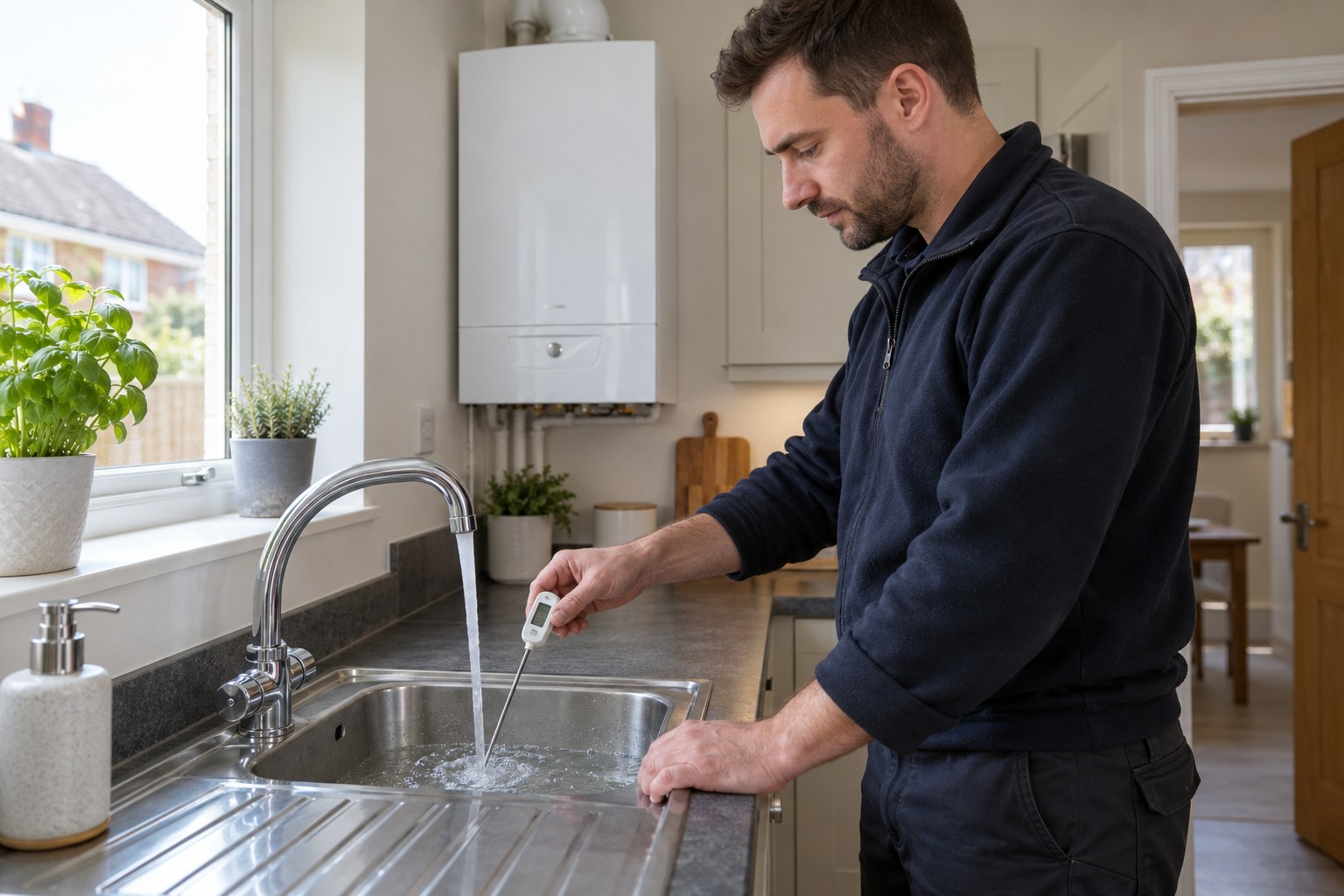
On a combi, the parts to check include the diverter valve, which switches the boiler between heating and hot water, the flow sensor that tells the boiler a tap is open, and the plate heat exchanger that heats mains water. On a system or regular boiler with a cylinder, the motorised zone valve, cylinder thermostat or programmer are more likely.
Signs you need a boiler hot water repair
- The radiators heat up as normal but the hot taps run cold
- The boiler does not fire at all when you open a hot tap, though it fires for heating
- Hot water comes through only when the heating is also on
- The water runs hot for a few seconds, then lukewarm, then hot again
- The cylinder stays cold even though the programmer shows hot water switched on
- A fault code appears on the boiler display each time hot water is called for
Hot water fault types explained
- Diverter valve faults. If the valve sticks in the heating position, the boiler’s primary heating water goes towards the radiators instead of heating the tap water through the heat exchanger. Some valves can be repaired with a new cartridge or actuator. Others need the whole valve body.
- Flow sensor or flow switch faults. If the boiler does not detect that a tap is open, it never fires for hot water. A blocked filter on the cold inlet can cause the same symptom.
- Scaled plate heat exchanger. In hard water areas, limescale builds up inside the plate heat exchanger and the water never gets properly hot. It may be descaled or replaced.
- Cylinder system faults. A zone valve that will not open, a failed cylinder thermostat or a faulty programmer can all stop a cylinder heating while the radiators still work.
- Pressure and condensate problems. Low system pressure or a frozen condensate pipe usually stops the boiler entirely. These are worth ruling out first because they can be cheap to sort.
What to include when asking for a quote
Say exactly what happens when you open a hot tap: does the boiler fire, does the display change, and does any warm water come through at all? Say whether you have a combi or a cylinder, and give the make and model from the data badge. If a fault code shows, write it down with any letters.
Mention when the fault started and anything that came before it, such as a cold snap, a recent service, a drop in pressure or new work on the plumbing. A combi in a hard water area that has slowly lost temperature over months points somewhere different from one that stopped overnight.
Ask whether the price is for diagnosis only or includes the likely part, and whether the van usually stocks parts for your make. A diverter valve or plate heat exchanger may have to be ordered, so ask how a second visit is charged.
How much does a boiler hot water repair cost?
| Type of job | Typical cost |
|---|---|
| Diagnosis and minor fix (pressure, filter, sensor clean) | £120–£180 |
| Flow sensor or diverter valve cartridge replaced | £180–£320 |
| Diverter valve body, plate heat exchanger or PCB | £320–£450+ |
These are indicative UK budgeting figures, not fixed quotes. Confirm parts, labour, VAT and any call-out charge with the business before booking.
Parts prices vary a lot between boiler makes, and a main control board on some models can push a repair past this range. If the repair quote is close to a third of the cost of a new boiler, ask the engineer how old the boiler is and how likely other parts are to fail soon.
The repair process: what to expect
- Basic checks. The engineer checks pressure, power, the condensate pipe and the programmer settings before opening the boiler.
- Fault finding. With the casing off, they test the diverter valve, flow sensor and temperature sensors, and on a cylinder system the zone valve and cylinder thermostat.
- Price and part. You get a price for the part and labour. Common parts may be on the van; others are ordered.
- Repair. The boiler is isolated, partly drained if needed, the part is fitted and the system refilled and bled.
- Testing. The engineer runs hot water and heating separately, checks the gas side is safe and resealed, and confirms the temperature at the taps.
Planning permission and building regulations
No planning permission is needed for a boiler repair, and replacing a faulty component like for like is not notifiable under Building Regulations. The law that matters is gas safety: anyone who works on a gas boiler for payment must be on the Gas Safe Register. Removing the boiler casing and changing internal parts counts. Do not open a sealed boiler yourself.
How to choose a boiler repair engineer
- Is the engineer Gas Safe registered, with domestic gas boilers on their card?
- Have they worked on your make of boiler before, and can they get genuine parts for it?
- Is there a call-out or diagnostic fee, and is it deducted if you go ahead with the repair?
- How long is the guarantee on the part and on the labour?
- If the boiler is old, will they tell you honestly whether the repair is worth it?
Frequently asked questions
Why do I have heating but no hot water?
On a combi, the most common causes are a sticking diverter valve, a faulty flow sensor or a scaled plate heat exchanger. On a boiler with a cylinder, look first at the zone valve, the cylinder thermostat and the programmer. An engineer needs to test the parts to be sure.
Is it worth repairing an older boiler?
It depends on the part, the age of the boiler and whether parts are still made. A diverter cartridge on a ten-year-old combi is usually worth fixing. A main board on a boiler near the end of its life may not be. Ask the engineer to put their view in writing.
Can I fix low boiler pressure myself?
Many combis can be topped up through the filling loop by following the manufacturer's instructions. If the pressure keeps dropping, there is likely a leak or a faulty pressure relief valve, and an engineer should find it. Never remove the boiler casing.
Why is my hot water only lukewarm?
Common causes are limescale in the plate heat exchanger, a tap opened too far for the boiler's output, a temperature set too low or a failing sensor. If it has got slowly worse over months, scale is a strong possibility.