
What is immersion heater replacement?
Immersion heater replacement means removing a failed electric element or its thermostat from a hot water cylinder and fitting a new one. The immersion sits inside the cylinder, screwed into a threaded boss either on top or on the side, and heats the stored water like a kettle element. It may be your only source of hot water, or a backup for a gas boiler.
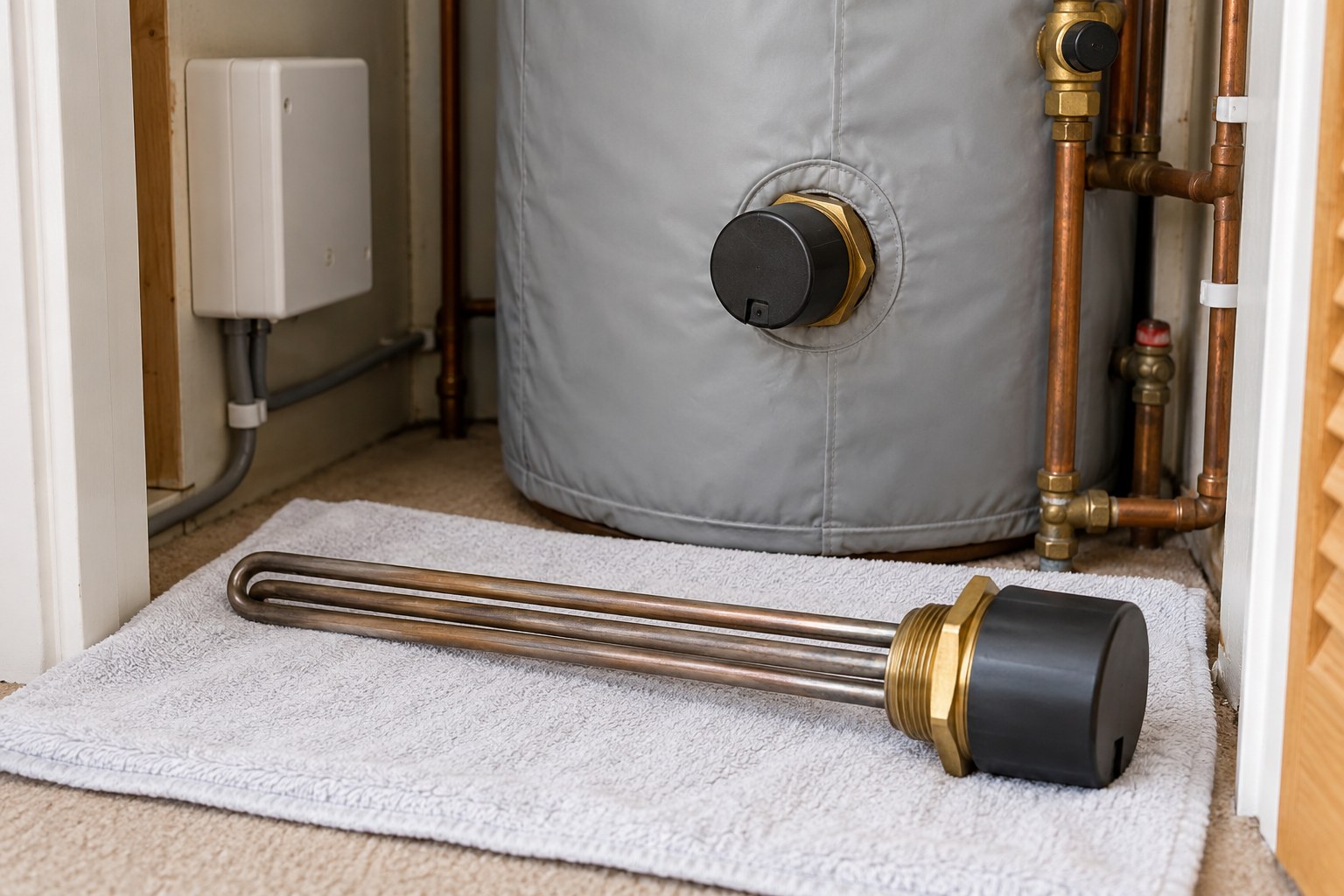
A failed immersion may only need a new thermostat, a cheaper and quicker job. A replacement element is needed when the element itself has burnt out, often because hard water has coated it in scale.
Signs you need immersion heater replacement
- The immersion switch is on but the cylinder stays cold
- The circuit breaker or RCD trips as soon as the immersion is switched on
- Water is only lukewarm even after hours of heating
- The immersion makes loud crackling or hissing sounds as it heats
- On a dual-element cylinder, one switch works and the other does nothing
- Water seeps from around the immersion boss on the cylinder
Immersion heater options explained
- Top-entry elements. Long elements, often 27 inches, that hang down from the top of the cylinder. They usually need only a small amount of water drained off.
- Side-entry elements. Shorter elements, often 11 inches, fitted low on the cylinder. The water must be drained below the boss, which takes longer.
- Dual elements. Older off-peak setups have two elements or a dual element, one for cheap-rate night heating and one for daytime boost.
- Element material. Standard copper elements are cheapest. Incoloy and titanium elements resist scale and corrosion better and are often recommended in hard water areas.
- Unvented cylinders. Pressurised cylinders need an element and safety controls that meet the cylinder manufacturer’s specification. The installer should check the exact model before ordering.
What to include when asking for a quote
Start by working out whether the cylinder is vented, with a cold tank in the loft, or unvented, which usually has a label, a pressure gauge and an expansion vessel nearby. Say whether the immersion goes in from the top or the side, and whether there are one or two switches. A photo of the top of the cylinder and the switch helps.
Describe what happens when you switch it on. Nothing at all, a tripped breaker and water that is only warm point to different faults: a failed thermostat, a burnt-out element or a wiring problem. Mention whether you are in a hard water area and when the element was last changed.
Ask whether the quote covers draining, the new element and thermostat, refilling, and electrical testing afterwards. Also ask what happens if the old element is seized in the boss, because forcing it out of an old copper cylinder can damage the cylinder.
How much does immersion heater replacement cost?
| Type of job | Typical cost |
|---|---|
| Immersion thermostat replaced, no draining | £150–£200 |
| Element and thermostat replaced in a vented cylinder | £200–£300 |
| Unvented cylinder element, or seized element removal | £300–£400+ |
These are indicative UK budgeting figures, not fixed quotes. Confirm parts, labour, VAT and any call-out charge with the business before booking.
The element itself is a small part of the price; the labour for draining and refilling is most of it. If the cylinder is badly corroded or the boss is damaged, the job may turn into a cylinder replacement, which costs far more.
The immersion replacement process: what to expect
- Isolate. The electrical supply is switched off and proved dead, and the cold feed to the cylinder is turned off.
- Test. The element and thermostat are tested to confirm which has failed.
- Drain. Water is drained to below the boss through the drain cock or by siphon.
- Swap. The old element is unscrewed with an immersion spanner and the new one fitted with a fresh washer.
- Refill and test. The cylinder is refilled and checked for leaks before power goes back on, then the heater is tested and the thermostat set.
The element must be fully covered with water before it is switched on. Running an element dry can burn it out in seconds.
Planning permission and building regulations
No planning permission is needed. In England, replacing an immersion heater like for like on an existing circuit is not usually notifiable under Part P of the Building Regulations, but adding a new circuit is. Ask about the applicable rules elsewhere in the UK. Work on an unvented cylinder's safety devices should be done by someone trained in unvented systems. The immersion heater advice from Electrical Safety First covers why the thermostat and safety cut-out matter. Stored hot water is usually kept at around 60 °C to control legionella.
How to choose an immersion heater engineer
- Will they test the element and thermostat before replacing both?
- Are they competent with the electrical side, or will an electrician connect it?
- Do they have unvented cylinder training if your cylinder is pressurised?
- Will they fit a scale-resistant element if you are in a hard water area?
- What will they do if the element is seized or the boss is damaged?
Frequently asked questions
Is it the element or the thermostat that has failed?
You cannot tell for sure without testing. An engineer checks the element's resistance and whether the thermostat switches. A thermostat is cheaper to replace, so testing first can save money.
Can I replace an immersion heater myself?
It involves electrics and draining a cylinder, and a seized element can damage the cylinder. On an unvented cylinder the part must meet the maker's specification. Most people are safer using an engineer who is competent with both the plumbing and the electrical side.
Why does my immersion element keep burning out?
Common causes are hard water scale building up on the element, the element being switched on before the cylinder was full, or the wrong element type. A scale-resistant Incoloy or titanium element can last longer in hard water areas.
Do I need a new cylinder if the immersion has failed?
Not usually. The element can be changed on its own. A new cylinder is only needed if the cylinder itself leaks, the boss thread is damaged or the copper is badly corroded.