
What is radiator valve replacement?
Radiator valve replacement means taking off the manual valves on a radiator, usually the wheelhead you turn by hand and the capped lockshield at the other end, and fitting new ones. It is needed when a valve seizes, snaps, will not shut off, or weeps from the body in a way that a simple tightening cannot fix.
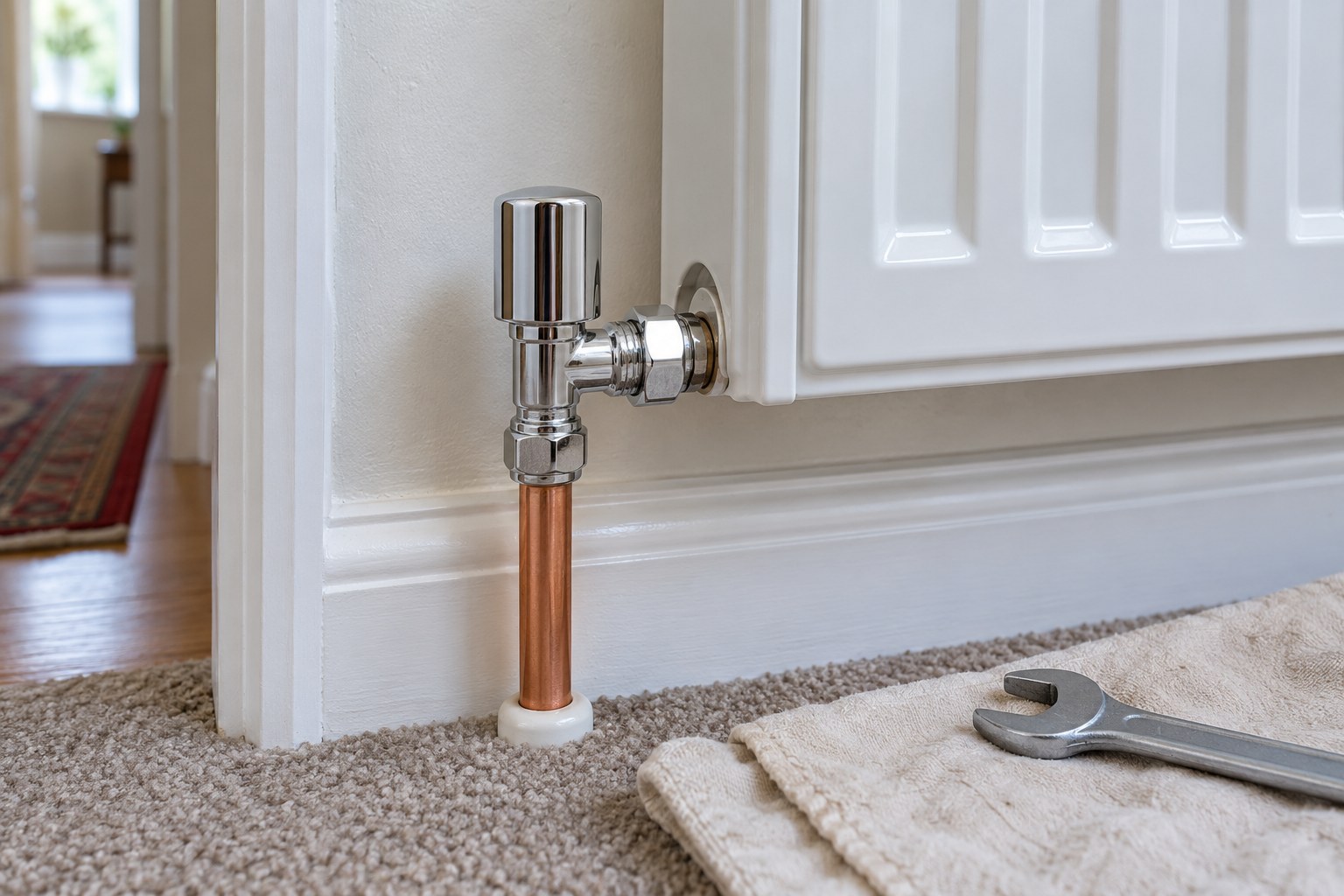
A full valve change opens the water circuit; a quick gland repair does not. The engineer either drains the system down below that radiator, or freezes the pipe with a freezing kit so the valve can be swapped without draining. Afterwards the system has to be refilled, bled and balanced.
Signs you need radiator valve replacement
- A wheelhead that spins freely but no longer opens or closes the radiator
- A valve seized solid so the radiator cannot be turned off for decorating or repairs
- A cracked or corroded valve body, or a tail that leaks again after being resealed
- A lockshield with a stripped or missing spindle, so the radiator cannot be balanced
- Mismatched or very old valves that you want to update when the room is decorated
Radiator valve types explained
- Wheelhead (manual) valves. A simple on/off control. They are cheap and reliable but give no room temperature control.
- Lockshield valves. These sit on the return end under a plastic cap. They are set once, when the system is balanced, so each radiator gets its share of flow. They are not meant for everyday use.
- Straight, angled and corner patterns. The pattern has to suit where the pipe comes from: up through the floor, out of the wall or from the side. Choosing the wrong one means extra pipework.
- Pipe size. Most homes run 15 mm copper to radiators. Some older systems use 8 mm or 10 mm microbore, which needs different valves or reducers.
- Swapping to thermostatic valves. If the system is being drained anyway, many people change the flow-side wheelhead for a TRV at the same time, so each room can be controlled on its own.
What to include when asking for a quote
Count how many valves need changing and in which rooms, and say what is wrong with each: seized, spinning, leaking or simply old. Take a photo of each valve showing where the pipe enters it, so the engineer can see whether it is a straight or angled pattern and whether the pipe is standard 15 mm or thinner microbore.
Say what system you have. A combi or sealed system is drained and refilled differently from an open-vent system with a feed tank in the loft. Mention when the system was last flushed and whether the water has run black when radiators were bled, because sludge can block new valves quickly.
Ask whether the quote includes draining or pipe freezing, refilling with inhibitor, bleeding and balancing the whole system, not just fitting the valves. Ask too whether chrome, white or designer valves are priced, as finishes can change the parts cost a lot.
How much does radiator valve replacement cost?
| Type of job | Typical cost |
|---|---|
| One valve changed using a pipe freezing kit | £100–£160 |
| Pair of valves on one radiator, system drained | £160–£260 |
| Several valves across the house, drained, refilled and balanced | £260–£400+ |
These are indicative UK budgeting figures, not fixed quotes. Confirm parts, labour, VAT and any call-out charge with the business before booking.
The drain-down and refill is a big share of the labour, so changing several valves in one visit costs less per valve than changing them one at a time. Designer valves, microbore adaptors and seized pipe fittings can add to the price.
The valve replacement process: what to expect
- Prepare. The boiler is switched off and allowed to cool, and floors are protected with dust sheets.
- Drain or freeze. The system is drained to below the radiator, or suitable pipe freezing and radiator isolation are used.
- Swap the valve. The old valve and tail are removed and the new valve fitted with a fresh tail into the radiator.
- Refill. The system is refilled, inhibitor is added and every radiator is bled.
- Balance. Lockshields are set so radiators near the boiler do not take all the flow and distant ones still warm up.
Planning permission and building regulations
Changing radiator valves needs no planning permission and is not notifiable on its own. In England, Approved Document L expects room-by-room temperature control when a boiler is replaced, which in most homes means TRVs. That rule does not force you to change valves now, but it is worth knowing if a boiler swap is coming. Landlords should keep a note of work done on the heating system.
How to choose a radiator valve installer
- Will they freeze the pipe or drain the system, and how long will the heating be off?
- Will they balance the whole system after fitting, not just open the new valves?
- Are the valves branded parts with spares available later?
- Is inhibitor included when the system is refilled?
- Can they handle microbore pipe if your house has it?
Frequently asked questions
What is the difference between a wheelhead and a lockshield valve?
The wheelhead is the valve you turn by hand to switch a radiator on or off. The lockshield, under a plastic cap at the other end, is set once to balance how much water flows through that radiator and is then left alone.
Can a radiator valve be changed without draining the system?
Often, yes. An engineer may be able to use pipe freezing together with radiator isolation while the valve is swapped. It depends on the pipe size, how easy it is to reach and whether the pipe is copper.
Why is one end of my radiator cold after a valve change?
The radiator may still hold air, or the system needs balancing so enough water reaches it. Bleeding usually fixes air. If it stays cold, the lockshield settings need adjusting.
Should I switch to thermostatic valves at the same time?
It is often sensible. The system is already being drained, so fitting a TRV on the flow side costs little extra labour, and each room can then be set to its own temperature.